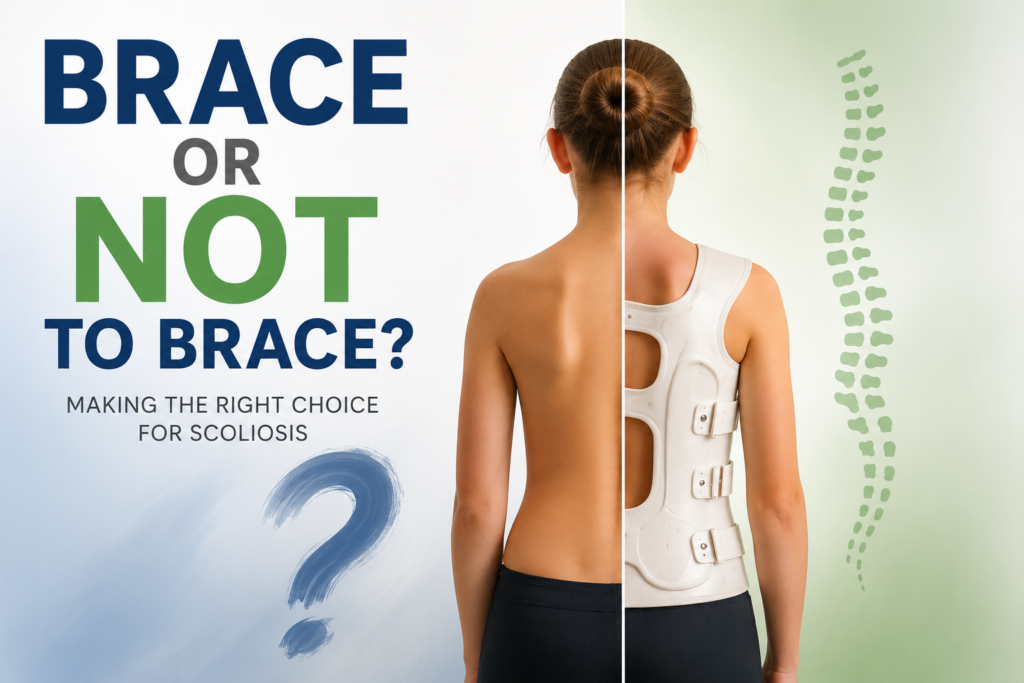
Short answer: No. Not every person with scoliosis needs a brace.
Many parents are surprised to learn that some cases of scoliosis simply need monitoring, while others benefit greatly from specific exercises or bracing. The right treatment depends on several factors, including the child’s age, growth potential, curve size, and the risk of progression.
At My Chiro Doc in Pretoria, we believe that every scoliosis patient deserves an individual assessment before deciding on the most appropriate treatment plan.
What Is A Scoliosis Brace?
A scoliosis brace is a custom-made device designed to help slow down or stop the progression of a spinal curve while a child is still growing.
Braces do not “cure” scoliosis, but research shows that appropriate bracing can significantly reduce the likelihood that a curve will worsen and require surgery.
The goal is to guide growth in a more favourable direction during the adolescent growth spurt.
When Is A Brace Usually Recommended?
Although every case is unique, current guidelines generally recommend considering bracing when:
- The patient is still growing
- The curve measures approximately 20–40 degrees
- There is evidence that the curve is progressing
- The child has significant growth remaining
Children who have already reached skeletal maturity often do not benefit from bracing in the same way as growing adolescents.
When A Brace May NOT Be Necessary
Not every scoliosis diagnosis automatically means a brace is needed.
Mild Curves
Curves below 20 degrees are often monitored and scoliosis specific exercises prescribed rather than braced, especially if there are no signs of progression.
Regular check-ups and follow-up imaging may be sufficient to ensure the condition remains stable.
Adults With Scoliosis
Adults with scoliosis generally do not wear corrective braces because growth has already stopped.
Management typically focuses on:
- Pain reduction
- Improving mobility
- Strengthening exercises
- Postural rehabilitation
- Maintaining function and quality of life
Stable Curves
Some children reach skeletal maturity without significant curve progression. In these cases, ongoing observation may be all that is required.
Can Exercises Replace A Brace?
This is one of the most common questions parents ask.
The answer is: sometimes, but not always.
Scoliosis-specific exercises can play an important role in treatment. These programmes aim to:
- Improve postural awareness
- Strengthen spinal stabilising muscles
- Enhance breathing mechanics
- Promote better three-dimensional alignment
- Support long-term spinal health
For mild curves, exercises alone may be appropriate.
For moderate curves in growing children, exercises are often combined with bracing to achieve the best possible outcomes.
The treatment plan should always be based on the individual child’s risk of progression.
What Types Of Braces Are Available?
Several types of scoliosis braces exist, including:
Rigid 3D Corrective Braces
These braces are custom-designed to provide three-dimensional correction and are commonly used for moderate to severe curves in growing adolescents.
Dynamic Braces
Dynamic systems, such as SpineCor braces, allow greater movement while still encouraging improved postural alignment.
The choice depends on factors such as:
- Curve pattern
- Severity
- Flexibility
- Age
- Lifestyle
- Growth potential
The Importance Of Early Assessment
Early detection gives families more treatment options.
When scoliosis is identified early, conservative approaches such as exercises and bracing are often more effective.
Parents should watch for signs including:
- Uneven shoulders
- One shoulder blade sticking out more than the other
- Uneven hips
- Clothing hanging unevenly
- A rib hump when bending forward
Most children with scoliosis experience little or no pain, which is why regular screening and early assessment are so important.
The Bottom Line
No, scoliosis does not always need a brace.
Some patients only require monitoring, while others benefit from scoliosis-specific exercises or a combination of exercise and bracing.
The key is determining the likelihood that the curve will progress and selecting the most appropriate treatment at the right time.
If you are concerned that your child may have scoliosis, a professional assessment can help you understand your options and develop an evidence-based management plan.
Book A Scoliosis Assessment In Pretoria
At My Chiro Doc, we provide comprehensive scoliosis assessments, conservative treatment options, exercise programmes, and guidance regarding bracing when appropriate.
Our goal is to help families make informed decisions and support children through every stage of growth and development.
